About Oceans2Earth

My photo
Oceans2Earth strives to assist with local solutions to global problems. O2E was founded in Melbourne, Australia in 2010 for the purpose of providing resources and financial assistance to animal welfare and conservation projects including elephant sanctuary land in Kenya, cat and dog rescue in Africa and community recycled product projects in Asia and Africa. The O2E Foundation aims to facilitate people’s awareness of the impacts of animal tourism, trade and human intervention on the welfare, sustainability and general health of wildlife populations.
Showing posts with label Elephant Week 2012. Show all posts

Thursday, 2 February 2012

Day Five : Elephants charging .. and why?

Hey! You’re in my space. Back off will ya?

Seems fair enough, doesn’t it?

Well the elephant can be just as clear with its meaning to back off too. You’ll get a warning – a mock charge – and then if you won’t take the hint – it WILL mean it.
Please note: Each elephant has its own distinctive character so don’t generalise about the difference between serious and mock charges. This is for interest only. Obviously you should stay away from an elephant. Leave it be.
Kenya Elephant Community

THE LEAD UP
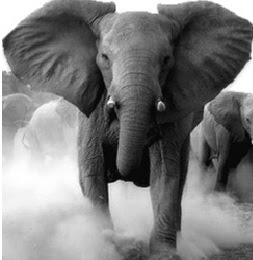
An aggressive elephant raises its head and trunk, extends its ears, trumpets and throws up clouds of dust by kicking the ground and shaking its head.
A lot of this activity initially involves displays of bravado and can be considered to be mock displays. By now, any species in its right mind will take notice of these threatening displays and take the necessary evasion action.

If the elephant however realises that attempts to intimidate have failed and still feels threatened, the elephant will likely then sway backwards and forwards before it charges.

In a serious charge the ears are held back against the neck and the trunk is tucked up against the chin.

Most charges are stopped before the target is reached. HOWEVER if an attack is followed through an elephant is quite capable of killing rhino and hippo, and of wrecking vehicles.


At top speed an elephant can travel at 40 km/h (25 miles/h).

However their biggest asset is not their speed. Their primary defense is their sheer bulk, tusks and trunk as well as their strength in numbers. Adult elephants have virtually no enemies except humans. Wonder why…

Day Four : That Amazing Trunk!

With estimated muscle counts ranging between 40,000 and 150,000, the trunk of an elephant is the most extraordinary and dexterous nose in creation. The trunk feels a bit like a hairy tree trunk or hard, crackly old leather! It’s extremely strong and yet gentle and sensitive as well, and is both capable of killing a lion - or caressing a frightened elephant calf.

It can pick leaves, strip branches, pull bark off trees, and pick up objects as small as a coin. It can suck up a gallon of water to squirt into a mouth or on a hot back (Elephants do not drink through their trunk, but use it to draw the liquid).


With their trunks elephants throw dust in the air, rub their eyes, greet one another, sound calls, test uncertain ground, smell danger--or a potential mate--and snorkel. African elephants have two lobes on the tips of their trunks (Asians have only one) that act like fingers.

Since elephants spend most of their time eating and drinking, those fingers get a steady workout, grasping seeds, roots, fruit, flowers, leaves, branches, bark, grass, and even thorns to pacify an incurable appetite.

Elephants can consume as much 300 pounds of forage a day, and up to 50 gallons of water. They drink whenever they can since they may have to go for a couple days or more without water during dry spells or while traveling.

Elephants are fast walkers and some herds have been observed to cover 120 miles in one day. However, 15 miles is a closer average for an elephant. More than most of us walk, anyway.

Elephants communicate a lot through touch, taste, and smell. A mother may bat her calf with her tail to make sure he is still following behind her, or she may turn and shove him as discipline. Two elephants who meet will "greet" with trunks outstretched, sniffing for clues about the other. (Incidentally, some scientists say that excited behaviour during greetings may suggest that elephants remember one another, even after being separated for many years.)


Elephants on alert will raise their trunks like periscopes, with the tips pointed toward whatever ill wind is blowing. They also can make more than 25 various vocalizations. Trumpets, screams, rumbles, and grunts all send a message, depending on how they are made.

A series of long, low rumbles may be a signal for the family to get up and move on. A trumpet may be a show of intimidation; a special soft hum is a mother's song to her newborn. Some calls are made only by females, only by males, or by calves.
Thanks to http://www.wildlife-pictures-online.com, http://oceans2earth.org/volunteer

Wednesday, 1 February 2012

Day Three : Asian Elephant


There are actually four subspecies of the Asian elephant, Elephas maximus: Elephas maximus maximus, found in Sri Lanka; Elephas maximus sumatranus, found in Sumatra and Borneo; Elephas maximus indicus, the mainland species found throughout South-east Asia; and last but not least, the Borneo pygmy elephant, Elephas maximus borneensis which was discovered in 2003. Slight variations exist in each subspecies, but nothing too drastic.

Asian elephants are huge gray animals inhabiting Asian tropical forests. Their gray coloration conceals them in their shady habitat. Elephants' trunks, unique among living mammals, are versatile, enabling them to reach the ground, manipulate tiny objects or tear down huge tree limbs, squirt water over their backs or into their mouths, or blow dirt onto their backs during dust baths. Female Asian elephants usually lack visible tusks as do males in some populations, such as those in northeast India. Wide, padded feet enable them to walk quietly. Large, flappable ears help these huge animals cool off, although elephants often must retreat to the shade or water during the hottest part of the day.

Asian elephants grow up to 21 feet long, stand up to 10 feet tall, and weigh up to 11,000 pounds. Females reach around eight and a half feet tall and weigh less than males. Despite their size, elephants are able to walk silently.
Asian elephants live in large blocks of forest near water sources and grasslands, habitat that has been greatly reduced in the last half century. They inhabit India, Sri Lanka, Myanmar (Burma), Indonesia, Thailand, Cambodia, Vietnam, Laos, Malaysia, Nepal, Bangladesh, and southern China.

The Asian elephant is listed as endangered on the World Conservation Union's (IUCN's) Red List of Threatened Animals.

Asian elephants inhabit a variety of tropical forest habitats from moist, evergreen lowland forest to dry semi-deciduous teak forests to cooler mountain forests up to 10,000 feet. They also frequent adjacent grasslands and farm areas. Their varied diet enables them to live in disturbed forests as long as they have plenty of space to move around and exploit different foods without coming into conflict with people.
A dexterous trunk and large, rasping molars allow Asian elephants to gather and process a wide variety of vegetation, including grasses and herbs, leaves, fruit, farm crops, and bark.

Older and larger males—especially those in musth (condition of heightened testosterone levels) dominate the breeding, winning the acceptance of females in heat. Gestation takes 20 to 22 months, and usually only one calf is born. Female Asian elephants can usually breed by age 14 and usually give birth to one young every four years.

In the wild, Asian elephants may live up to about 60 years but most do not live that long. Female and young male Asian elephants live in cohesive herds of related adults and their offspring. The matriarch, usually the oldest and largest female, sets the pace of the group's activities. Herds often join with others to form large groups called clans. Males leave herds at puberty, around their 13th year, and travel alone or in bachelor groups. Elephants wander widely in search of food. Movements vary widely depending upon food availability. Asian elephants communicate via rumbles, growls, bellows, and moans. Some of these varied, low-frequency sounds may travel a mile or more.

Past/Present/Future: Asian elephants once ranged from Iraq east through Asia south of the Himalayas, into southern China and possibly south to Java. However, centuries of hunting and habitat destruction caused dramatic declines. Males are still killed for their tusks, although this happens less often today thanks to a global ivory ban, in place since 1989. Today, Asian elephants thrive mostly in large remote reserves as well as in and among human habitation. Where elephants and people inhabit the same area, conflicts often occur.

Elephants can cause great damage to crops, and they occasionally kill people. Males in musth are responsible for the majority of attacks. Elephants play important roles in the cultures and religions of countries in most of their range, which inspires support for habitat protection measures, continued studies about elephants and their conservation needs, and efforts to mitigate conflicts between elephants and people.

Order: Proboscidea
Family: Elephantidae
Genus and Species: Elephas maximus

Day Two : African Savanna 
Elephant


Male African elephants of the savanna (species - Loxodonta 
africana) species grow up to 25 feet long, stand up to 11 feet tall and weigh up to 14,000 pounds. Males are usually larger than females.

African elephants live in many parts of sub-Saharan Africa, although their range is now broken into patches. Small numbers of forest elephants live in dense equatorial forests of Central Africa from Zaire west to Mauritania, while savanna elephants are far more widespread in drier woodlands and savannas. Savanna elephants are now most common in Kenya, Tanzania, Botswana, Zimbabwe, Namibia, and South Africa. The suspected third species lives in both savanna and forest in west Africa.

African elephants are listed as endangered on the World Conservation Union's Red List of Threatened Animals.

African elephants live wherever they can find enough food and water with minimal disturbance from people. Most of the continent's elephants live on savannas and in dry woodlands. In some regions, they occur in desert areas; in others, they are found in mountains. In Congo and other equatorial countries, forest elephants live in dense tropical rain forest.

A dexterous trunk and large, rasping molars allow African elephants to gather and process a wide variety of vegetation. During the rainy season, savanna elephants usually seek out grasses and herbs. During other times of year, they frequent forests, especially those by streams, where they also eat leaves, fruit, and bark from a variety of plants. Elephants supplement the sodium in their food by visiting mineral licks.

Older and larger males—especially those in “musth” (condition of heightened testosterone levels)—dominate the breeding, winning the acceptance of females in heat. Gestation lasts 22 months, and usually only one calf is born. Female African savanna elephants can usually breed by age ten and give birth to one young every four years.

Females and young males live in cohesive herds of about ten related adults and their offspring. The matriarch, usually the oldest and largest female, sets the pace of the group's activities. Males leave herds at puberty, around their 13th year, and travel alone or in bachelor groups. Elephants travel widely in search of food. Movements vary depending upon food availability. African elephants communicate with rumbles, growls, bellows, and moans. Some of these varied, low-frequency sounds may travel a mile or more.

The average life span of an African savanna elephant in the wild is 60 years.
Past/Present/Future: African elephants once lived throughout Africa; they now inhabit no more than one-third of the continent and are gone from the Sahara. Over the past 150 years, ivory hunters have ruthlessly hunted them for their tusks. Between 1979 and 1989, Africa's elephant population plummeted from 1,300,000 animals to 750,000, due mostly to ivory hunting. Since the 1980s, an international ban on trade in ivory has helped many populations hold steady or rebound.

However, African elephants have lost much of their habitat to ranches, farms, and desertification. The forest elephant, always far less common than the savanna subspecies, is under threat from logging and market hunting for its meat. African elephants are now found mostly in reserves. In some parks, confined elephant populations have major impacts on habitat, changing open forests into grasslands.

Sunday, 29 January 2012

O2E celebrates Elephant Week

With poaching at a high coming in 2012 we thought we would celebrate elephants for the wonderful, majestic creatures they are.

Firstly here’s an update on the poaching/ivory trade issues. Stay tuned each day this week with our “elephant-a-day” blog filled with interesting facts about these beautiful pachyderms.

Poaching and Ivory Smuggling at Record Highs in 2011
________________________________________


Poaching of elephants and the illegal trade in their tusks and related ivory products were out of control in 2011, with more than 2,500 animals confirmed killed and thousands of kilograms of tusks seized by customs officials around the world. This was the worst year on record since the international ivory trade ban was established in 1989, according to TRAFFIC, the wildlife trade monitoring network.

Most of the poaching—which is increasingly conducted by well-armed gangs from Asia and almost exclusively targets the elephants’ valuable ivory tusks—takes place in Africa, where two African elephant species (Loxodonta africana and Loxodonta cyclotis, the second of which was only recognized as its own species in 2010) still have a population of around 450,000 animals. That’s a far cry from the estimated 1.2 million that were living in the 1970s and the 600,000 that lived when the ivory trade ban was enacted. African elephants are listed as “Vulnerable” to extinction by the International Union for Conservation of Nature and Natural Resources (IUCN) Red List of Threatened Species. The IUCN lists Asian elephants (Elephas maximus, including three subspecies) as “Endangered,” with an estimated 40,000 to 50,000 animals in existence.

Final numbers for ivory seizures are still being calculated, but TRAFFIC International reported last week that there were 13 large-scale ivory seizures in 2011. By “large scale,” they mean at least 800 kilograms of ivory. The largest seizure was last month in Kenya, where a 2,575-kilogram shipment of 727 pieces of ivory was discovered in a shipping container en route to Asia. TRAFFIC points out that even this number of seizures is not a disincentive for the criminal gangs behind the smuggling because arrests rarely occur and punishments for those who are arrested are minor under existing laws.

Other large ivory seizures included a 1,100-kilogram shipment found in Vietnam in September and a 2,234-kilogram shipment in China in April. The total weight for the 13 shipments was more than 23 metric tons. There were just six such large-scale seizures in 2010, totaling 9,798 kilograms. Some shipments contained full tusks. Others contained a combination of tusks and ivory carvings.

According to TRAFFIC, these large-scale seizures represent ivory from at least 2,500 slain elephants, if not more. This does not include hundreds of smaller seizures, accounts for which are still being compiled, and probably represents a fraction of total elephant poaching in Africa and Asia as well as ivory smuggling around the world. A 2009 report from the International Fund for Animal Welfare estimated that poachers were killing more than 100 African elephants daily.

“In 23 years of compiling ivory-seizure data…this is the worst year ever for large ivory seizures,” Tom Milliken, manager of TRAFFIC’s Elephant Trade Information System, said in a prepared statement. “The escalating large ivory quantities involved in 2011 reflect both a rising demand in Asia and the increasing sophistication of the criminal gangs behind the trafficking. Most illegal shipments of African elephant ivory end up in either China or Thailand.”
Three of the largest seizures took place in Malaysia. Another three seizures had been shipped through Malaysia before they were confiscated.

Poaching nearly disappeared after the 1989 ivory trade ban but it has come back strong in recent years. The boom has been fueled primarily by two factors: growing affluence in Asia and the greater number of shipping options. “Not only have people got more cash, but the transport infrastructure has got much better—there are more flights connecting Asian markets than ever before,” James Compton, TRAFFIC senior director for Asia–Pacific, told The New York Times.

These same factors are also behind the rise in rhino poaching. In 2011 at least 443 rhinos were killed for their horns in South Africa, the only country that can accurately report on rhino poaching counts. This is also a high, up from 333 rhinos poached in that country in 2010.

Although it’s easy to blame the booming Asian economy for much of this, it’s important to remember that the U.S. is also a very large market for illegal ivory. A study released in 2008 found that Americans are the world’s second-largest consumers of elephant ivory products.

Taken from the Scientific American.