About Oceans2Earth

My photo
Oceans2Earth strives to assist with local solutions to global problems. O2E was founded in Melbourne, Australia in 2010 for the purpose of providing resources and financial assistance to animal welfare and conservation projects including elephant sanctuary land in Kenya, cat and dog rescue in Africa and community recycled product projects in Asia and Africa. The O2E Foundation aims to facilitate people’s awareness of the impacts of animal tourism, trade and human intervention on the welfare, sustainability and general health of wildlife populations.
Showing posts with label Elephants. Show all posts

Sunday, 5 February 2012

Day Seven : Our Favourite Ele pics!

We hoped you enjoyed this week celebrating elephants.

We have put together this collage to show what remarkable, intelligent, wonderful creatures they truly are. Photos are of both Asian and African elephants and are complements of Oceans2Earth, Wildlife Pictures Online or National Geographic.

We need to work together and diligently to save them from harm and indeed, extinction.


Friday, 3 February 2012

Day Six : Other stuff about the Elephant

Do elephants have good memories?

Elephants seem to have one of the best memories of all animals.

The long lifespan of elephants do require that they have a good memory. There is proof that elephants have recognized urine samples from group members they had been separated from for a few decades.

This good memory is very beneficial for survival when knowledge about where to find food, water and security is very useful during extreme climatic cycles.

Did you know an elephant’s height can be estimated from the size of its footprint?


Its footprint can determine the height of an elephant. For males shoulder height is approximately 5,8 time the length of the hind footprint (and in the case of females 5,5 times).

An elephant’s foot generally measures 40 - 50 centimetres in length and width and has a circumference of about 1.34 meters.


The footprint can also indicate the age of an elephant. Younger elephants leave a more defined footprint than older elephants that might have smoother ridges and well-worn heels.

All mammals can be divided into different groups based on their foot posture while standing. Elephants fall into a group called near-ungulates, which refers to the fact that they have toenails rather than hooves.

An elephant’s foot is designed in such a way that elephants actually walk on the tips of their toes. African elephants have 4 nails on their front feet and 3 nails on their back feet. These nails are worn down and do not always show on their footprints. The sole of the foot is covered in a thick epidermal layer tissue that acts like shock absorbers. This allows the elephant to move surprisingly silently.


The ridges and grooves give it a good grip some stability when walking over a variety of terrains. The reason that elephants can walk so quietly is in part due to the fibro elastic layer providing a spongy cushion on the bottom of the foot. This allows the foot to mould over objects on the ground thereby effectively smothering the objects beneath it.

How do African elephants sleep?


African elephants can sleep standing up for a few minutes at a stretch but they do lie down in order to sleep more deeply. Adult elephants sleep for about 3 to 4 hours at night, a whole family group at the same place and time, while young elephants are sometimes overcome by sleep at other times. Then you can see their mothers patiently guarding their sleep.

Elephants even snore at times. They will also lie down in the heat of the day for an hour or two.


Can elephants swim?

Elephants enjoy showering by sucking water into their trunks and spraying it all over themselves. Afterward, they often spray their skin with a protective coating of dust.


If it is possible an elephant goes to water once a day to drink, bathe and wallow in mud. On average it will drink 70 to 90 litres a day but it can down 150 litres when thirsty. Wallowing in mud is an important activity for elephants. It cools them off and it protects its skin against parasites.


In deep water an elephant will immerse itself completely. Elephants can swim across lakes and rivers with only the tip of their trunks showing. Elephants shower themselves with dust and sand for the same reasons. Sand also acts as a useful substance to help dislodge ticks when the elephant rubs itself on rocks and trees.
You may visit our site, oceans2earth.org/volunteer to enjoy many more projects which will surely be turn into your best experience of rejuvination. 

Thursday, 2 February 2012

Day Five : Elephants charging .. and why?

Hey! You’re in my space. Back off will ya?

Seems fair enough, doesn’t it?

Well the elephant can be just as clear with its meaning to back off too. You’ll get a warning – a mock charge – and then if you won’t take the hint – it WILL mean it.
Please note: Each elephant has its own distinctive character so don’t generalise about the difference between serious and mock charges. This is for interest only. Obviously you should stay away from an elephant. Leave it be.

Kenya Elephant Community

THE LEAD UP
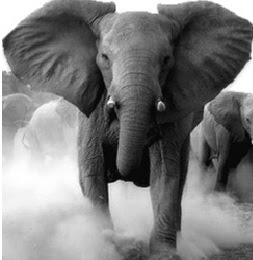
An aggressive elephant raises its head and trunk, extends its ears, trumpets and throws up clouds of dust by kicking the ground and shaking its head.
A lot of this activity initially involves displays of bravado and can be considered to be mock displays. By now, any species in its right mind will take notice of these threatening displays and take the necessary evasion action.

If the elephant however realises that attempts to intimidate have failed and still feels threatened, the elephant will likely then sway backwards and forwards before it charges.

In a serious charge the ears are held back against the neck and the trunk is tucked up against the chin.

Most charges are stopped before the target is reached. HOWEVER if an attack is followed through an elephant is quite capable of killing rhino and hippo, and of wrecking vehicles.


At top speed an elephant can travel at 40 km/h (25 miles/h).

However their biggest asset is not their speed. Their primary defense is their sheer bulk, tusks and trunk as well as their strength in numbers. Adult elephants have virtually no enemies except humans. Wonder why…

Day Four : That Amazing Trunk!

With estimated muscle counts ranging between 40,000 and 150,000, the trunk of an elephant is the most extraordinary and dexterous nose in creation. The trunk feels a bit like a hairy tree trunk or hard, crackly old leather! It’s extremely strong and yet gentle and sensitive as well, and is both capable of killing a lion - or caressing a frightened elephant calf.

It can pick leaves, strip branches, pull bark off trees, and pick up objects as small as a coin. It can suck up a gallon of water to squirt into a mouth or on a hot back (Elephants do not drink through their trunk, but use it to draw the liquid).


With their trunks elephants throw dust in the air, rub their eyes, greet one another, sound calls, test uncertain ground, smell danger--or a potential mate--and snorkel. African elephants have two lobes on the tips of their trunks (Asians have only one) that act like fingers.

Since elephants spend most of their time eating and drinking, those fingers get a steady workout, grasping seeds, roots, fruit, flowers, leaves, branches, bark, grass, and even thorns to pacify an incurable appetite.

Elephants can consume as much 300 pounds of forage a day, and up to 50 gallons of water. They drink whenever they can since they may have to go for a couple days or more without water during dry spells or while traveling.

Elephants are fast walkers and some herds have been observed to cover 120 miles in one day. However, 15 miles is a closer average for an elephant. More than most of us walk, anyway.

Elephants communicate a lot through touch, taste, and smell. A mother may bat her calf with her tail to make sure he is still following behind her, or she may turn and shove him as discipline. Two elephants who meet will "greet" with trunks outstretched, sniffing for clues about the other. (Incidentally, some scientists say that excited behaviour during greetings may suggest that elephants remember one another, even after being separated for many years.)


Elephants on alert will raise their trunks like periscopes, with the tips pointed toward whatever ill wind is blowing. They also can make more than 25 various vocalizations. Trumpets, screams, rumbles, and grunts all send a message, depending on how they are made.

A series of long, low rumbles may be a signal for the family to get up and move on. A trumpet may be a show of intimidation; a special soft hum is a mother's song to her newborn. Some calls are made only by females, only by males, or by calves.
Thanks to http://www.wildlife-pictures-online.com, http://oceans2earth.org/volunteer

Wednesday, 1 February 2012

Day Three : Asian Elephant


There are actually four subspecies of the Asian elephant, Elephas maximus: Elephas maximus maximus, found in Sri Lanka; Elephas maximus sumatranus, found in Sumatra and Borneo; Elephas maximus indicus, the mainland species found throughout South-east Asia; and last but not least, the Borneo pygmy elephant, Elephas maximus borneensis which was discovered in 2003. Slight variations exist in each subspecies, but nothing too drastic.

Asian elephants are huge gray animals inhabiting Asian tropical forests. Their gray coloration conceals them in their shady habitat. Elephants' trunks, unique among living mammals, are versatile, enabling them to reach the ground, manipulate tiny objects or tear down huge tree limbs, squirt water over their backs or into their mouths, or blow dirt onto their backs during dust baths. Female Asian elephants usually lack visible tusks as do males in some populations, such as those in northeast India. Wide, padded feet enable them to walk quietly. Large, flappable ears help these huge animals cool off, although elephants often must retreat to the shade or water during the hottest part of the day.

Asian elephants grow up to 21 feet long, stand up to 10 feet tall, and weigh up to 11,000 pounds. Females reach around eight and a half feet tall and weigh less than males. Despite their size, elephants are able to walk silently.
Asian elephants live in large blocks of forest near water sources and grasslands, habitat that has been greatly reduced in the last half century. They inhabit India, Sri Lanka, Myanmar (Burma), Indonesia, Thailand, Cambodia, Vietnam, Laos, Malaysia, Nepal, Bangladesh, and southern China.

The Asian elephant is listed as endangered on the World Conservation Union's (IUCN's) Red List of Threatened Animals.

Asian elephants inhabit a variety of tropical forest habitats from moist, evergreen lowland forest to dry semi-deciduous teak forests to cooler mountain forests up to 10,000 feet. They also frequent adjacent grasslands and farm areas. Their varied diet enables them to live in disturbed forests as long as they have plenty of space to move around and exploit different foods without coming into conflict with people.
A dexterous trunk and large, rasping molars allow Asian elephants to gather and process a wide variety of vegetation, including grasses and herbs, leaves, fruit, farm crops, and bark.

Older and larger males—especially those in musth (condition of heightened testosterone levels) dominate the breeding, winning the acceptance of females in heat. Gestation takes 20 to 22 months, and usually only one calf is born. Female Asian elephants can usually breed by age 14 and usually give birth to one young every four years.

In the wild, Asian elephants may live up to about 60 years but most do not live that long. Female and young male Asian elephants live in cohesive herds of related adults and their offspring. The matriarch, usually the oldest and largest female, sets the pace of the group's activities. Herds often join with others to form large groups called clans. Males leave herds at puberty, around their 13th year, and travel alone or in bachelor groups. Elephants wander widely in search of food. Movements vary widely depending upon food availability. Asian elephants communicate via rumbles, growls, bellows, and moans. Some of these varied, low-frequency sounds may travel a mile or more.

Past/Present/Future: Asian elephants once ranged from Iraq east through Asia south of the Himalayas, into southern China and possibly south to Java. However, centuries of hunting and habitat destruction caused dramatic declines. Males are still killed for their tusks, although this happens less often today thanks to a global ivory ban, in place since 1989. Today, Asian elephants thrive mostly in large remote reserves as well as in and among human habitation. Where elephants and people inhabit the same area, conflicts often occur.

Elephants can cause great damage to crops, and they occasionally kill people. Males in musth are responsible for the majority of attacks. Elephants play important roles in the cultures and religions of countries in most of their range, which inspires support for habitat protection measures, continued studies about elephants and their conservation needs, and efforts to mitigate conflicts between elephants and people.

Order: Proboscidea
Family: Elephantidae
Genus and Species: Elephas maximus

Day Two : African Savanna 
Elephant


Male African elephants of the savanna (species - Loxodonta 
africana) species grow up to 25 feet long, stand up to 11 feet tall and weigh up to 14,000 pounds. Males are usually larger than females.

African elephants live in many parts of sub-Saharan Africa, although their range is now broken into patches. Small numbers of forest elephants live in dense equatorial forests of Central Africa from Zaire west to Mauritania, while savanna elephants are far more widespread in drier woodlands and savannas. Savanna elephants are now most common in Kenya, Tanzania, Botswana, Zimbabwe, Namibia, and South Africa. The suspected third species lives in both savanna and forest in west Africa.

African elephants are listed as endangered on the World Conservation Union's Red List of Threatened Animals.

African elephants live wherever they can find enough food and water with minimal disturbance from people. Most of the continent's elephants live on savannas and in dry woodlands. In some regions, they occur in desert areas; in others, they are found in mountains. In Congo and other equatorial countries, forest elephants live in dense tropical rain forest.

A dexterous trunk and large, rasping molars allow African elephants to gather and process a wide variety of vegetation. During the rainy season, savanna elephants usually seek out grasses and herbs. During other times of year, they frequent forests, especially those by streams, where they also eat leaves, fruit, and bark from a variety of plants. Elephants supplement the sodium in their food by visiting mineral licks.

Older and larger males—especially those in “musth” (condition of heightened testosterone levels)—dominate the breeding, winning the acceptance of females in heat. Gestation lasts 22 months, and usually only one calf is born. Female African savanna elephants can usually breed by age ten and give birth to one young every four years.

Females and young males live in cohesive herds of about ten related adults and their offspring. The matriarch, usually the oldest and largest female, sets the pace of the group's activities. Males leave herds at puberty, around their 13th year, and travel alone or in bachelor groups. Elephants travel widely in search of food. Movements vary depending upon food availability. African elephants communicate with rumbles, growls, bellows, and moans. Some of these varied, low-frequency sounds may travel a mile or more.

The average life span of an African savanna elephant in the wild is 60 years.
Past/Present/Future: African elephants once lived throughout Africa; they now inhabit no more than one-third of the continent and are gone from the Sahara. Over the past 150 years, ivory hunters have ruthlessly hunted them for their tusks. Between 1979 and 1989, Africa's elephant population plummeted from 1,300,000 animals to 750,000, due mostly to ivory hunting. Since the 1980s, an international ban on trade in ivory has helped many populations hold steady or rebound.

However, African elephants have lost much of their habitat to ranches, farms, and desertification. The forest elephant, always far less common than the savanna subspecies, is under threat from logging and market hunting for its meat. African elephants are now found mostly in reserves. In some parks, confined elephant populations have major impacts on habitat, changing open forests into grasslands.

Sunday, 29 January 2012

O2E celebrates Elephant Week

With poaching at a high coming in 2012 we thought we would celebrate elephants for the wonderful, majestic creatures they are.

Firstly here’s an update on the poaching/ivory trade issues. Stay tuned each day this week with our “elephant-a-day” blog filled with interesting facts about these beautiful pachyderms.

Poaching and Ivory Smuggling at Record Highs in 2011
________________________________________


Poaching of elephants and the illegal trade in their tusks and related ivory products were out of control in 2011, with more than 2,500 animals confirmed killed and thousands of kilograms of tusks seized by customs officials around the world. This was the worst year on record since the international ivory trade ban was established in 1989, according to TRAFFIC, the wildlife trade monitoring network.

Most of the poaching—which is increasingly conducted by well-armed gangs from Asia and almost exclusively targets the elephants’ valuable ivory tusks—takes place in Africa, where two African elephant species (Loxodonta africana and Loxodonta cyclotis, the second of which was only recognized as its own species in 2010) still have a population of around 450,000 animals. That’s a far cry from the estimated 1.2 million that were living in the 1970s and the 600,000 that lived when the ivory trade ban was enacted. African elephants are listed as “Vulnerable” to extinction by the International Union for Conservation of Nature and Natural Resources (IUCN) Red List of Threatened Species. The IUCN lists Asian elephants (Elephas maximus, including three subspecies) as “Endangered,” with an estimated 40,000 to 50,000 animals in existence.

Final numbers for ivory seizures are still being calculated, but TRAFFIC International reported last week that there were 13 large-scale ivory seizures in 2011. By “large scale,” they mean at least 800 kilograms of ivory. The largest seizure was last month in Kenya, where a 2,575-kilogram shipment of 727 pieces of ivory was discovered in a shipping container en route to Asia. TRAFFIC points out that even this number of seizures is not a disincentive for the criminal gangs behind the smuggling because arrests rarely occur and punishments for those who are arrested are minor under existing laws.

Other large ivory seizures included a 1,100-kilogram shipment found in Vietnam in September and a 2,234-kilogram shipment in China in April. The total weight for the 13 shipments was more than 23 metric tons. There were just six such large-scale seizures in 2010, totaling 9,798 kilograms. Some shipments contained full tusks. Others contained a combination of tusks and ivory carvings.

According to TRAFFIC, these large-scale seizures represent ivory from at least 2,500 slain elephants, if not more. This does not include hundreds of smaller seizures, accounts for which are still being compiled, and probably represents a fraction of total elephant poaching in Africa and Asia as well as ivory smuggling around the world. A 2009 report from the International Fund for Animal Welfare estimated that poachers were killing more than 100 African elephants daily.

“In 23 years of compiling ivory-seizure data…this is the worst year ever for large ivory seizures,” Tom Milliken, manager of TRAFFIC’s Elephant Trade Information System, said in a prepared statement. “The escalating large ivory quantities involved in 2011 reflect both a rising demand in Asia and the increasing sophistication of the criminal gangs behind the trafficking. Most illegal shipments of African elephant ivory end up in either China or Thailand.”
Three of the largest seizures took place in Malaysia. Another three seizures had been shipped through Malaysia before they were confiscated.

Poaching nearly disappeared after the 1989 ivory trade ban but it has come back strong in recent years. The boom has been fueled primarily by two factors: growing affluence in Asia and the greater number of shipping options. “Not only have people got more cash, but the transport infrastructure has got much better—there are more flights connecting Asian markets than ever before,” James Compton, TRAFFIC senior director for Asia–Pacific, told The New York Times.

These same factors are also behind the rise in rhino poaching. In 2011 at least 443 rhinos were killed for their horns in South Africa, the only country that can accurately report on rhino poaching counts. This is also a high, up from 333 rhinos poached in that country in 2010.

Although it’s easy to blame the booming Asian economy for much of this, it’s important to remember that the U.S. is also a very large market for illegal ivory. A study released in 2008 found that Americans are the world’s second-largest consumers of elephant ivory products.

Taken from the Scientific American.

Saturday, 28 January 2012

What you must know about Elephants

It is estimated that there were once more than 350 species of elephants in the world. Today we only have two of them left – the Asian and the Africa species. Both of them are at risk of extinction if more intense efforts to protect them aren’t in place. Between illegal hunting of them for ivory as well as the destruction of their natural habitat things are simply closing in on them at an alarming rate.

African elephants once lived throughout Africa; they now inhabit no more than one-third of the continent and are gone from the Sahara. Over the past 150 years, ivory hunters have ruthlessly hunted them for their tusks. Between 1979 and 1989, Africa's elephant population plummeted from 1,300,000 animals to 750,000, due mostly to ivory hunting. Since the 1980s, an international ban on trade in ivory has helped many populations hold steady or rebound.

However, African elephants have lost much of their habitat to ranches, farms, and desertification. The forest elephant, always far less common than the savanna subspecies, is under threat from logging and market hunting for its meat. African elephants are now found mostly in reserves. In some parks, confined elephant populations have major impacts on habitat, changing open forests into grasslands.
When you compare the two species of elephants you will notice quite a few differences among them.

There are some sub species in each of these groups to mention. With the Asian elephants there are the Indian, Sri Lanka, Sumatran, and Borneo which is also called the Pygmy. Researchers are still conducting testing right now but there is a theory that a 5th sub species does exist……bit like the yeti….?
Elephant Description:
Order: Proboscidea
Family: Elephantidae
Genus and Species: eg. Loxodonta africana

Stay tuned as from tomorrow onwards, O2E celebrates Elephant Week!

Sunday, 8 January 2012

Carol Buckley tackles India's treatment of elephants


Earlier this week we looked at the growing problem of elephant poaching and the illegal ivory trade, which has risen to its highest levels since the 1989 international trade ban on ivory products went into place. Today we look at a positive project in India, one meant to rescue some captive Indian elephants (Elephas maximus indicus) from the unhealthy and often-abusive conditions that they currently endure.

The animals are currently trapped in a kind of legal purgatory. In 2009 India’s Central Zoo Authority, a government body that owns all of India’s zoos, mandated that all elephants be removed from the nation’s zoos and circuses. The authority issued the order, which will eventually affect about 146 animals, after a five-year study by a citizens’ committee found zoo life can be profoundly unhealthy for the animals. Unfortunately, the elephants have had no place to go.


Life in the worst Indian zoos “can be quite horrible,” says Carol Buckley, co-founder and former director of The Elephant Sanctuary in Tennessee and now founder of Elephant Aid International. In some, elephants spend their lives in stark concrete bunkers where they are perpetually chained and can barely move. Animals who are somewhat better off can also suffer. “There’s a zoo in Bangalore where a family of elephants is exhibited on a tiny dirt yard during the day where they can barely turn around,” Buckley notes, but when the zoo closes each day, the animals are released into the bordering forest.

Buckley is about to leave for Bangalore, India, where her nonprofit intends to build the first Elephant Care and Rehabilitation Center, currently in the planning stages. When completed, the 80-hectare facility is expected to become home to seven former zoo elephants and to be a model for other rehabilitation centers throughout India. “Once everything is working smoothly, the government will jump on and replicate this effort throughout India,” Buckley says. She also expects the government to take in hundreds of other privately owned elephants, such as those living in temples.

This is the first real action since the mandate was issued. Buckley says the government originally thought the elephants would be moved into government-run forest camps, where wild elephants—usually “rogues” that have threatened humans—are often “broken” and given jobs like carrying soldiers on anti-poaching patrols. “The elephants in these camps are usually trained and maintained quite brutally, but they’re also allowed to stay in the forest most of their lives,” Buckley says. “The government assumed that these zoo elephants could be absorbed into forest camps, but camp directors said no, this won’t work. There was no recognition that the elephants would need a rehabilitation phase where they would be reconditioned to live in a wild environment and collect their own food.”

That’s where Buckley came in. After visiting India around the time that the mandate passed, she proposed creating rehab centers where the elephants could be taught to be semi-wild and live the rest of their lives in a forested setting. It took two years to get government approval for the project, which was finally granted in November.

When Buckley arrives in India in two weeks, she says, she will walk the land that has been acquired for the facility, determining where to build fences and working with Wildlife Rescue and Rehabilitation, a partner organization, to learn how to work with Indian contractors. “I have a very clear vision about fencing, what elephants should be allowed to do, and how much freedom they need to thrive,” she says. Other infrastructure that must be built includes shade structures, corral areas for medical attention and training (as well as sleeping), a veterinary lab and administrative office, plus housing for staff. The site already includes a 12-hectare facility that will be adapted for some of these needs.

The veterinarians will be provided by the government, but Buckley plans to recruit the rest of the staff, which will include a dedicated mahout (Hindi for elephant trainer) for each of the resident elephants. The mahouts themselves will be trained in the compassionate elephant management technique developed by Buckley, which eschews the traditional pain-based training methods used throughout India. Most mahouts (as well as many Western trainers) control animals by jabbing a sharp metal pole and hook combination called the ankus into elephants’ mouths, ears and other sensitive areas. Buckley’s technique instead uses food and praise as positive reinforcement and focuses on building a relationship between elephants and their mahouts. “The mahout is like a shepherd,” she says. “They will allow the elephants to graze in daytime and then corral them and bring them home at night. You have to have someone to watch out over the animals.” The center will have a full-time facility director, as well as housekeepers, cooks and other staff. “Everything that is normal in Indian society,” Buckley says.

The facility will also attend in other ways to the needs of the people who will work in the rehab center and those who live nearby. “When I started the Elephant Sanctuary in Tennessee, I didn’t have to consider much beyond elephant welfare,” Buckley says. “But in India, I also need to address human welfare. The programs I have developed have a strong component for education, not just for the public but also addressing the public welfare of the mahouts and their families.” By ensuring that the mahouts are well paid and provided for, she says, she’ll ensure that they will in turn be there to take care of the animals’ needs.

The total cost for the rehab center is estimated at $200,000. Elephant Aid International is accepting donations to help make it a reality.

Source : Scientific American

Monday, 19 December 2011

A must watch: The Elephant Tree!


Watch the elephants knock the fruit out of the tree and all the animals eat
it off the ground. This is a real video from a French documentary about Africa. You may not understand French, but the video is funny.

There are trees that grow in Africa which, once a year, produce very juicy fruit that contain a high percentage of alcohol.

The tree is known as the "Elephant Tree" because elephants have a fondness for the fruit. Because there is a shortage of water in that area, as soon as the fruits are ripe, animals come there to help relieve themselves of the heat. You will easily know who has over-indulged!

The tree is the Marula tree. You can buy a great liqueur named "Amarula" which is made with the fruit and causream.
Volunteer Australia with Oceans2Earth make your holidays, the most memorable part of your life.

Friday, 2 December 2011

The rescue of a new born elephant named Sasab

We received this email today from the David Sheldrick Trust. Read on to find out more :


The David Sheldrick Trust received a call early in the morning of November 8th about a tiny elephant calf that had been rescued within the West Gate Community Conservancy having been robbed of his family by the flood waters of the Ewaso Niro river. Early that same morning a community guard named 'Hospitali'. happened upon this tiny calf grappling in the fast flowing flood waters, obviously having been washed, tumbled and bumped down river by the raging torrent.

This region has experienced heavy rains for a number of weeks, and while beautifully green, and food now plentiful, baby elephants during this time are extremely vulnerable when crossing the swollen Ewaso Niro river.'Hospitali' pulled the calf to the safety of dry land, and once the tiny baby had regained his strength, walked the calf the kilometer to Sasaab Lodge where 'Hospitali' works. Ali and Tony Allport, the managers of Sasaab Lodge, contacted the Kenya Wildlife Service Senior Warden for the district reporting the plight of the tiny calf. Locating the calf's herd in this vast area, with no idea of how far downstream he had even been swept was clearly not an option, and so it was decided that he required the support of The David Sheldrick Wildlife Trust.

The rescue plane landed at the Kipsing airfield and the team was met by Tony and taken to the lodge where the tiny little male calf waited their arrival. Still pink behind the ears, and clearly very hungry he immediately took the milk offered to him without too much resistance. After that his bumps and bruises from being swept down river were treated with the magical green clay, before he was prepared for his one hour flight back to Nairobi.


On arrival back at the Nursery he was clearly exhausted by his ordeal, fed again and then in the comfort of his stable, with a Keeper close at hand finally slept. Later he was introduced to the others, and immediately settled knowing that he had his elephant family once again. Little babies this age, while incredibly fragile and difficult to raise on formula, do not suffer the same emotional trauma elephants of five months and older feel. Too young to fully comprehend events he soon settled into Nursery life, and while he loves the company of the other orphans he is absolutely hooked on his Keepers.

The Trust keepers have named this tiny little calf Sasab, and a couple of weeks on from his rescue he has just sprouted his first tooth, which normally happens at four weeks old. We therefore suspect Sasab was just two weeks when orphaned.

To view a film of Sasab's rescue please click on this link:
http://sheldrickwildlifetrust.org/asp/orphan_profile.asp?N=262


To foster Sasab please click this link:
https://www.sheldrickwildlifetrust.org/asp/foster.asp?nn=1&G=&LP=11252011445-pic7a.jpg&addn=262&N=262&FN=SASAB


To Volunteer Check
http://oceans2earth.org/all-projects

Sunday, 13 November 2011

Plea to “retire” tourist Elephant in Cambodia


Sambo is a 51 year old female elephant in Phnom Penh in Cambodia and her “job” is to give tourists rides.

The people at EARS, the Elephant Asia Rescue and Survival Foundation http://www.earsasia.org/home.html have written to tell us all about this sad story.

Sambo would have been captured, wrenched away from her family as an infant in the wilds of Cambodia and ‘domesticated’, enduring the frightening, painful and cruel training methods that seem common world-wide for elephants being ‘broken’ for a life in captivity.
This is itself is an extremely traumatic experience, and like humans, elephants feel deep loss and pain.

Sambo has to carry tourists around the Wat Phnom temple in a heavy chair strapped to her back, wearing rubber shoes to protect the sensitive soles of her feet from the hot pavements, but other than that her owner has neglected her foot care is being neglected. Elephants in the wild are fastidious about their feet. In the wild elephants will often walk many miles a day, across and through many different substrates, some moisturizing, some abrasive. Wild elephants will use
their feet when grazing, specifically their toes, to strike and sever bamboo and coarse blades of grass. This continual striking across the abrasive grasses benefits the feet by wearing the area between the toes where the nails and cuticles can overgrow. Routine grazing aids foot health by
naturally manicuring the cuticles and nails.

Poor Sambo’s feet are kept covered in the rubber shoes while working and then she is returned to a two-acre compound of damp, grassy wasteland behind a casino, which is also used as a coach park. In such unsuitable surroundings it is vital that she receives good, routine foot care but this is clearly not happening.

Born Free Foundation’s Senior Veterinary Consultant, John Knight reports that Sambo’s condition is poor and she has major foot damage and appears to be in severe pain. She continually raises her right back foot to relieve the pressure on a large, deep abyss in the sole of that foot. “This animal needs to be rested, to be properly
examined, and she may need radiology and other tests to
fully assess her condition. With proper veterinary attention it may be possible to make a substantial improvement to her condition but treatment, rest and improved management needs to start straight away.”

Thanks to letters already written to the authorities, Sambo has had her working days reduced from a whopping seven days a week, to four days on / three days off. This is considered by those supporting Sambo’s cause as a step in the right direction – but it’s just not good enough.

There needs to be a TOTAL BAN on elephant capture, ride and domestication. Not only in Cambodia but worldwide.

 Thailand has banned elephants from the cities because of complaints from tourists and to prevent traffic accidents. This is due to pressure from people like yourselves and that the country wants to improve its image and keep tourists safe and happy. This is a good step forward but you can still ride elephants and see them perform in shows all throughout Thailand.

Cambodia is starting to look at improving its image with international visitors and recently Phnom Penh authorities requested that macaque monkeys at Wat Phnom temple (where Sambo is worked) were moved to an animal rescue centre as many tourists had been bitten. Funny that, eh?

It would be fantastic if Sambo too could have a new home. It’s too late for Sambo to be returned to the wild but she deserves a restful, pampered retirement and there are elephant sanctuaries in Cambodia that can take Sambo. We need to persuade the authorities to insist her owner retire her.

WHAT YOU CAN DO:
In Asian culture, it is important to allow people to “save face” and we must be polite and respectful in how we champion this cause.

Please write to the authorities below. In written letter is preferable to email – but if you don’t have time or can’t see yourself typing up a letter and popping it in the post box then by all means email away! Better an email than nothing at all….

EARS suggest the following approach:
Say… “you welcome the fact that Sambo has had her working hours reduced but unfortunately this is not enough. She needs to be taken out of work immediately, and receive urgent veterinary treatment for the appalling condition of her feet. She is likely to be enduring great pain at this time. She also needs to be re-homed to a sanctuary in Cambodia where she can be provided with elephant company and care and a lifestyle appropriate for this species.

It is vital that Sambo is not merely retired and replaced so can you point out, politely, that there needs to be a ban on elephants living and working in Phnom Penh. Phnom Penh is a fascinating city with stunning architecture and much to delight the visitor; the archaic sight of an elephant giving rides in the city can only harm the image international visitors will receive.
Thank you.”

1. GOVERNOR OF PHNOM PENH:
Mr H.E Kep Chuk Tema, Governor of Phnom Penh
City Hall
No. 69 Preah Monivong Boulevard
Sangkat Wat Phnom
Khan Daun Penh
Phnom Penh
Cambodia

2. DIRECTOR GENERAL OF FORESTRY ADMINISTRATION:
Mr H.E Cheng Kimsun, Royal Delegate in Charge of Director
General of
Forestry Administration
No. 200 Norodom Boulevard
Phnom Penh
Cambodia

3. MINISTER OF TOURISM:
Mr H.E Dr. Thong Khon, Minister of Tourism
No. 3 Preah Monivong Boulevard
Phnom Penh, Cambodia

For more information and progress on the campaign to help Sambo please click here.


Sambo at work, strapped into the chair for tourists to sit in, wearing rubber soles to protect her feet