About Oceans2Earth

My photo
Oceans2Earth strives to assist with local solutions to global problems. O2E was founded in Melbourne, Australia in 2010 for the purpose of providing resources and financial assistance to animal welfare and conservation projects including elephant sanctuary land in Kenya, cat and dog rescue in Africa and community recycled product projects in Asia and Africa. The O2E Foundation aims to facilitate people’s awareness of the impacts of animal tourism, trade and human intervention on the welfare, sustainability and general health of wildlife populations.

Thursday, 17 November 2011

Animal-friendly Christmas Suggestions Part 1

XMAS IS ROUND THE CORNER
Give a gift that keeps on giving


We are such a consumer society. How often do you find it a challenge to find something for friends and family at the gift-giving time...everyone seems to have everything they need! What to do?

The animal kingdom could do with the Christmas cheer. What about a gift double headed this year? Buy a gift or donate through the various charities and NGOs that can put your dollars to work where it’s really needed.

O2E has put together some suggestions for you to take the chore out of Christmas and to bring back “L-O-V-E and Peace To All”. These suggestions will come in different parts over the next few weeks following up to Christmas so keep an eye out for new posts!

So the first two suggestions we have are to Donate and to Adopt! Read on for more information :) 


DONATE

The recent floods in Thailand have stretched the services and staff of the WFFT to the limit. Hundreds of dogs and cats have been rescued by Edwin Weik and WFFT and sent to the Centre for rehabilitation and safe haven. From first-hand experience O2E Volunteers can tell you how much food and care these residents need. A donation would be much appreciated!


You can make a donation by going to the following link :


ADOPT

There are over 400 animals at WFFT and many of them are available for adoption. You receive an A4 colour Adoption Certificate and regular updates by email. You can to speak directly to the Centre regarding adoption on volunteer@wfft.org, stating which animal/s you are interested in adopting, if you like.

Prices are as follows:
1 year’s adoption: $50 US / 35 Euros
2 year’s adoption: $80 US / 55 Euros
5 year’s adoption: $200 US / 140 Euros

Primates for adoption include these gorgeous darlings.


Zack 
White-cheeked Gibbon (Nomascus leucogenys)
Maa Mii
Siamang (Symphalangus Syndactylus)
Gilbert
Pileated Gibbon
(Hylobates pileatus)
Nee 
White-handed Gibbon
(Hylobates lar)
Nin 
Golden-cheeked Gibbon
(Nomascus gabriellae)
You can also adopt Elephants, Bears, a variety of wildlife and nocturnal animals too!

So what are you waiting for? Make someone's (be they animal or human!) Christmas this year a special one! 

Wednesday, 16 November 2011

Random Animal Fact Day : The African Elephant

Weighing up to 6000 kg (6.6 tons) and measuring up to 3.3 m (10 ft.) at the shoulder, the African elephant is the world's largest land mammal. It is characterized by its highly dexterous trunk, long curved tusks, and massive ears.
As African elephants act as a keystone species, it is vital to take steps in their conservation. Poaching and urban sprawl pose a massive threat to their survival.
Now classified as a near threatened species under IUCN's Red List, African elephants had benefited greatly from the 1989 Convention on International Trade in Endangered Species (CITES) ban on ivory. This measure was taken in response to the widespread obliteration of nearly half the African elephant population that took place in the preceding decade. However, with newer, more relaxed laws against ivory, as well as continuing human encroachment, the African elephant remains in trouble.
What You Can Do to Help
There are several ways to help support African elephants. For starters, don't buy, sell, or wear ivory. Also, participate in eco-tourism. Boosting Africa's economy through eco-tourism helps placate local residents who view elephants as pests. In addition, you can donate to or fundraise for the Elephant Corridor, a project that enables elephants in Botswana to roam freely across the border to Zambia.
Finally, help provide captive elephants with the best possibly life. Boycott circuses, whose unethical treatment includes chaining elephants up by their feet and trunks, as well as beating them frequently. Encourage zoos to create environments similar to African elephants' native habitat. They should be able to encompass elephant families and their travel patterns, and they should be located in a warm climate so that the elephants can spend all year outside. that the elephants can spend all year outside.

Sunday, 13 November 2011

Plea to “retire” tourist Elephant in Cambodia


Sambo is a 51 year old female elephant in Phnom Penh in Cambodia and her “job” is to give tourists rides.

The people at EARS, the Elephant Asia Rescue and Survival Foundation http://www.earsasia.org/home.html have written to tell us all about this sad story.

Sambo would have been captured, wrenched away from her family as an infant in the wilds of Cambodia and ‘domesticated’, enduring the frightening, painful and cruel training methods that seem common world-wide for elephants being ‘broken’ for a life in captivity.
This is itself is an extremely traumatic experience, and like humans, elephants feel deep loss and pain.

Sambo has to carry tourists around the Wat Phnom temple in a heavy chair strapped to her back, wearing rubber shoes to protect the sensitive soles of her feet from the hot pavements, but other than that her owner has neglected her foot care is being neglected. Elephants in the wild are fastidious about their feet. In the wild elephants will often walk many miles a day, across and through many different substrates, some moisturizing, some abrasive. Wild elephants will use
their feet when grazing, specifically their toes, to strike and sever bamboo and coarse blades of grass. This continual striking across the abrasive grasses benefits the feet by wearing the area between the toes where the nails and cuticles can overgrow. Routine grazing aids foot health by
naturally manicuring the cuticles and nails.

Poor Sambo’s feet are kept covered in the rubber shoes while working and then she is returned to a two-acre compound of damp, grassy wasteland behind a casino, which is also used as a coach park. In such unsuitable surroundings it is vital that she receives good, routine foot care but this is clearly not happening.

Born Free Foundation’s Senior Veterinary Consultant, John Knight reports that Sambo’s condition is poor and she has major foot damage and appears to be in severe pain. She continually raises her right back foot to relieve the pressure on a large, deep abyss in the sole of that foot. “This animal needs to be rested, to be properly
examined, and she may need radiology and other tests to
fully assess her condition. With proper veterinary attention it may be possible to make a substantial improvement to her condition but treatment, rest and improved management needs to start straight away.”

Thanks to letters already written to the authorities, Sambo has had her working days reduced from a whopping seven days a week, to four days on / three days off. This is considered by those supporting Sambo’s cause as a step in the right direction – but it’s just not good enough.

There needs to be a TOTAL BAN on elephant capture, ride and domestication. Not only in Cambodia but worldwide.

 Thailand has banned elephants from the cities because of complaints from tourists and to prevent traffic accidents. This is due to pressure from people like yourselves and that the country wants to improve its image and keep tourists safe and happy. This is a good step forward but you can still ride elephants and see them perform in shows all throughout Thailand.

Cambodia is starting to look at improving its image with international visitors and recently Phnom Penh authorities requested that macaque monkeys at Wat Phnom temple (where Sambo is worked) were moved to an animal rescue centre as many tourists had been bitten. Funny that, eh?

It would be fantastic if Sambo too could have a new home. It’s too late for Sambo to be returned to the wild but she deserves a restful, pampered retirement and there are elephant sanctuaries in Cambodia that can take Sambo. We need to persuade the authorities to insist her owner retire her.

WHAT YOU CAN DO:
In Asian culture, it is important to allow people to “save face” and we must be polite and respectful in how we champion this cause.

Please write to the authorities below. In written letter is preferable to email – but if you don’t have time or can’t see yourself typing up a letter and popping it in the post box then by all means email away! Better an email than nothing at all….

EARS suggest the following approach:
Say… “you welcome the fact that Sambo has had her working hours reduced but unfortunately this is not enough. She needs to be taken out of work immediately, and receive urgent veterinary treatment for the appalling condition of her feet. She is likely to be enduring great pain at this time. She also needs to be re-homed to a sanctuary in Cambodia where she can be provided with elephant company and care and a lifestyle appropriate for this species.

It is vital that Sambo is not merely retired and replaced so can you point out, politely, that there needs to be a ban on elephants living and working in Phnom Penh. Phnom Penh is a fascinating city with stunning architecture and much to delight the visitor; the archaic sight of an elephant giving rides in the city can only harm the image international visitors will receive.
Thank you.”

1. GOVERNOR OF PHNOM PENH:
Mr H.E Kep Chuk Tema, Governor of Phnom Penh
City Hall
No. 69 Preah Monivong Boulevard
Sangkat Wat Phnom
Khan Daun Penh
Phnom Penh
Cambodia

2. DIRECTOR GENERAL OF FORESTRY ADMINISTRATION:
Mr H.E Cheng Kimsun, Royal Delegate in Charge of Director
General of
Forestry Administration
No. 200 Norodom Boulevard
Phnom Penh
Cambodia

3. MINISTER OF TOURISM:
Mr H.E Dr. Thong Khon, Minister of Tourism
No. 3 Preah Monivong Boulevard
Phnom Penh, Cambodia

For more information and progress on the campaign to help Sambo please click here.


Sambo at work, strapped into the chair for tourists to sit in, wearing rubber soles to protect her feet

Thursday, 10 November 2011

Justice is served! Zimbabwe Rhino poachers to be jailed

Two poachers will serve a 16 year jail term each after they were convicted of illegally hunting two rhinoceros worth $120 000 at Sango Ranch in Bikita, Zimbabwe.
Poachers,  Maera and Mwapfa and other two accomplices went to Sango Ranch in Bikita in July this year and killed a rhino.
The following month in company of Emerson Jamukoko and Hardlife Mukombi they allegedly then killed a black female rhino using an unlicensed AK-47 assault rifle and dehorned its horns.
Police at Buffalo Range airport received information about the poachers operations and laid an ambush which led to their arrest.
Police recovered AK 47 rifle and two rounds of ammunition. The poachers then led police to the scene where they committed the crime.
Cases of poaching are on increase in the country, with various environmentalists leading campaigns against such activities in the country. Unfortunately, it’s a very lucrative business. Even top politicians in the country have been linked to poaching syndicates. The issue is centuries in the making and not only involves hunting and poaching but man’s ties to an old tradition and culture.


Black Rhinoceros. Distinguished from the white rhino by its larger size and pointed, flexible upper lip. The black is also more aggressive than the white. Rhinoceroses can gallop at speeds of up to 40-45kph. YIKES!


White rhinoceros - not in fact white but slate-grey to yellowish-brown in colour . The ‘white’ likely comes from a mistranslation of the Afrikaner word for ‘wide’, referring to the animal’s wide mouth. It’s rather more square than the black rhino’s lips. He also has a longer head and a more pronounced shoulder hump
Campaigns to educate local communities are having an impact and in-country newspaper The Zimbabwean, often covers the story and have reported several times this year on the plight of the rhinos and the increasing endangerment of these beautiful, majestic animals.
In June 2011, more than 350 people gathered to celebrate Rhino Day. The Minister of Environment Francis Nhema spoke to open the event which marks the beginning of a new thrust in efforts to promote the protection of the rhino.
He said, “It is a celebration of successful conservation strategies implemented by various individuals, organisations and companies who are pulling their resources to conserve the rhino from poaching. The primary objective is to create awareness on the plight of the rhino and help stem illegal trade in rhino and rhino products worldwide.”


 The Opening of Zimbabwean Rhino Day
Marching to the beat of the Zimbabwean Police Band, school children with banners saying “Rhino horn is not medicine” and “My horn belongs on my head” joined activists from the Ministry of Environment, Zimbabwe Parks and Wildlife Management Authority and various other groups concerned with conservation and animal welfare.
WHAT YOU CAN DO
The Tikki Hywood Trust is a project which will not only help secure the threatened population of rhinos and other lesser known endangered species, but it also creates awareness for them. The Trust aims to prevent such crisis management of Zimbabwe’s other endangered wildlife by initiating breeding projects and importing new blood strains to strengthen the genetic base of the existing populations.
NEVER EVER BUY IVORY PRODUCTS.
Ivory looks and feels like a white or off-white hard substance (sometime grainy, sometimes polished up), almost like bone. If you aren’t sure, ask the vendor what the product is made of. If they don’t know, don’t buy it.

Visit Oceans2Earth for More:-

Tuesday, 18 October 2011

Australia needs humane live export laws!

'Wherever there are industries that profit from the abuse of animals; wherever the eyes of the public aren't looking; animals are at great risk.' Lyn White, Animals Australia.

The recent, shocking images on Australian tv were enough to make anyone cringe. I confess, I haven't been able to bring myself to watch them. My imagination runs rampant and I can't help but wonder why people behave the way they do. It seems logical that animals would be stunned before they are sliced, diced or out and out killed, doesn't it? Obviously that is not logical to some nor is the treatment of livestock with dignity and empathy. Therefore the responsibility must fall to exporters to ensure that stunning occur. Again - logical? Again - obviously not! It falls to us, as responsible, caring human beings of the general population to express our concerns and insist that this practice be legislated. Don't sell our livestock to ANYONE, ANY COUNTRY, ANY COMPANY who doesn't stun. SIMPLE.

Thank you to everyone who chose not to look away and sign the petitions, write to their government representatives & educate their friends to legislate & enforce livestock stunning before slaughter. The road is long but starts with each small step.

What can you do? Please log on to Animals Australia who are doing such an awesome job on this project and follow their simple list of "Take Action" things you can do. It does make a difference. Truly.

Monday, 17 October 2011

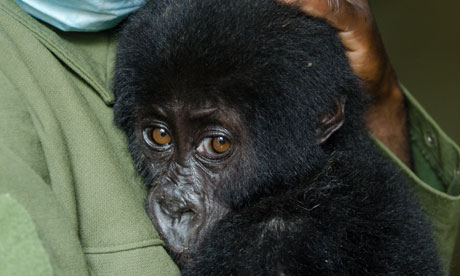
New threat to endangered Congo gorilla

Sadly there are only approximately 480 gorillas in the Virunga volcano area of the Democratic Republic of Congo, with less than 800 worldwide.
Whilst authorities have sought to crack down on the illegal poaching of these gorgeous creatures, it appears that they are fighting an uphill battle. In its fourth raid since April, an anti-poaching raid uncovered this little guy hidden in a rucksack!


Photo courtesy of Guardian post UK

Four babies have been recovered this year alone. Unfortunately these raids only scratch the surface of this wildlife trading issue. Ape Alliance thinks that the Middle East is a large source of demand with wealthy animal collectors and the local tradition of soliciting favours with large, exotic gifts. Poachers can claim in excess of $40,000USD ($26,000UK) for each gorilla kidnapped from its parents and natural habitat.

It goes without saying that such an incentive may be seen as attractive to a poor Congo local.

You can help by:
  1. talk to your friends
  2. share this blog
  3. contact Ape Alliance (www.4apes.com) to register your support
  4. Volunteer Australia with O2E

Tuesday, 4 October 2011

Report on the decline of wild cats and dogs

Eighty percent of all wild cat species are experiencing population declines, as are 25 percent of wild canids - the family of foxes, wolves and wild dogs. The report looks beyond the raw numbers and delves into the plight of 15 of these species that are considered ecologically vital (www.ifaw.org for full report details).


  • A century ago there were as many as 200,000 lions living in Africa, today there are fewer than 30,000. Lions are now extinct from 26 countries that they formerly occupied. The single greatest threat to lions is killing by people who own livestock. Herders and ranchers shoot, trap and poison lions across their range.
  • There are fewer than 500 Darwin’s Fox living today. The animal are found only in Chile and their restricted distribution makes them highly vulnerable to extinction. The gentle and curious canids are not fearful of people which contributes to their endangerment, however timber exploration and land development are the two biggest factors that have pushed the animals to the brink.
  • There are fewer than 7,000 snow leopards in the wild today. Snow leopard poaching is rampant with their bones and hides frequently confiscated in illegal shipments of wildlife parts bound for markets in China and throughout Asia.
  • Fewer than 500 Ethiopian wolves remain with more than half found in the Bale Mountains. The highly social animals live in packs which makes them especially vulnerable when their populations decrease. Entire packs are wiped out by rabies outbreaks, while those that survive face rapid loss of habitat.
  •  One of the most ecologically and genetically unique animals, African wild dogs exist in less than seven percent of their historic range, and are extinct in 22 countries that they formerly inhabited. Accidental snaring and rabies have decimated populations throughout Africa, and fewer than 8,000 of the animals remain.


Wow!


African Wild Dog
8,000 left